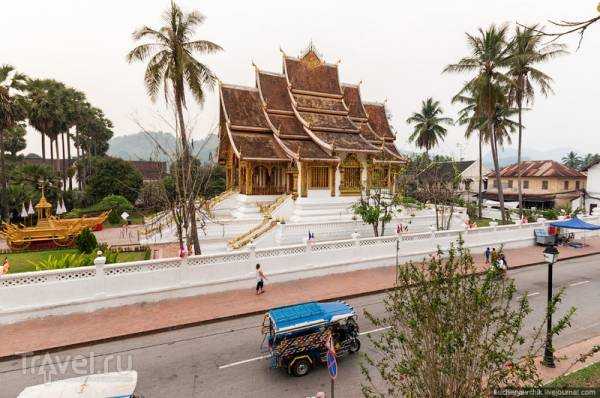
Vientiane is an unusual capital. The ceremonial spirit here is enough for exactly one central street. The four-lane highway with painted curbs and lanterns stretches from the presidential palace to the triumphal arch and shows how well-groomed and neat Laos could be. Vientiane is divided into a good main street with a couple of adjacent blocks, and the rest of the city. These two parts need to be written about separately - they are so different.

I flew from Luang Prabang to Vientiane on a Lao airline. There were six of us in the 20-row ATR cabin: my friend, me, another European couple and two Lao. A nice stewardess demonstrated the safety rules just like on any other plane in the world. The only local color on the flight was a magazine advertising a Mercedes in Lao and a stewardess with narrow eyes. A flight on an Italian plane with international safety requirements is boring!

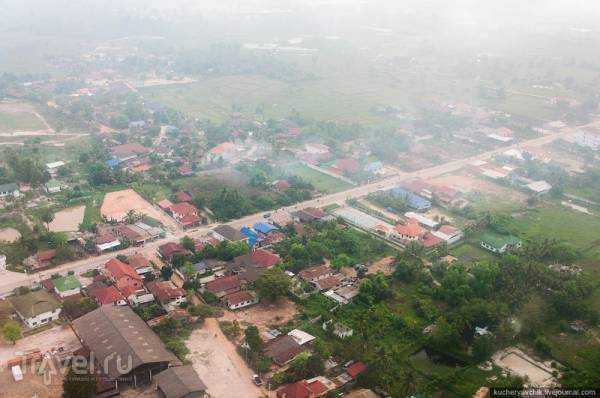
The flight was flying over a very picturesque region of Laos, but the ground was barely visible from the window. A damp, low fog covered the ground, the rainy season was approaching.

Only when approaching Vientiane, shortly before landing, could the outlines of houses be seen.
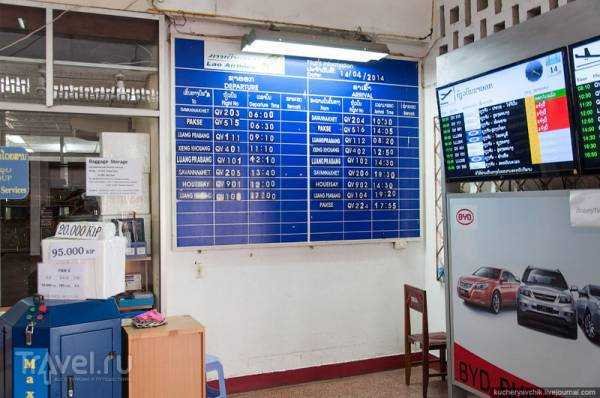
I really wanted to experience something exotic and until the last moment I hoped that the domestic flight in Laos would be carried out by some AN-24-type plane given to us by the USSR in exchange for bananas. I wanted us to be shaken during takeoff and thrown from side to side during landing, but the flight went without any inconveniences. During the flight we were not even fed - just like at home! The exotic met us at the descent from the ramp: an arrivals board with signs and a non-working conveyor, assembled, by the look of it, from tank steel.
We left the airport building and went to look for a bus to the city. We walked five hundred meters to the intersection with a large road. The traffic was controlled by a traffic light! You can count the controlled intersections in Laos on your fingers, and this traffic light was one of ten.

We jumped on a passing city bus. The conductor helped us carry our backpacks. The passengers were smiling. In Laos, people smile everywhere and always – I will remember this pleasant attitude forever.
We tried to find out where the bus was going. The bus route sign was written in Lao script. Not a single person on board spoke English. I showed the conductor a map of Vientiane, but the Lao cannot read European maps. I found out later that no country in Asia knows how to use European maps. I will tell you about the maps you need to take with you to Asia when I write a report about China. In my conversation with the conductor, I tried to use my kitchen French: “centre”, “ville”, “de ville” and so on in the same spirit - the conductor still did not understand that we wanted to go to the city. She laughed, gave us tickets and went on to talk to the driver.

The bus, against our will, was not going to Vientiane, but to the suburbs. The route passed through the large Vientiane agglomeration. At first we drove along an asphalt avenue with guardrails, then turned onto a road with potholes, then drove off the potholes onto a dirt road and finally, after about 40 minutes, we ran into some temple in the middle of a palm grove somewhere far away in the outskirts.

We passed villages where large families lived in one-story huts under a canopy of palm leaves, we saw the cool mansions of rich Lao with their love of gilding and plaster columns on the facade, and one long, endless bazaar.

Along all the roads of Laos (later, this rule also proved to be useful in Vietnam and China) there is an endless row of shops where something is always sold. All of Asia is one endless bazaar stretched along the road.

On the way back, the bus passed the intersection where we got on and went to the center of Vientiane. We dragged ourselves along some absolutely faceless streets, only the houses became taller: first two, then three, and even four floors of concrete slabs. So unnoticeably we entered the historical center. On a gold plate on one of the fences through the bus window I read the inscription “presidential palace”. This building was marked on the European map of Vientiane in my guidebook, from here you could already catch a tuk-tuk to the hostel. But there was one problem - we knew the specific address, but could not explain it in Lao.

People in Laos live in abject poverty: high infant mortality, non-literacy on an African scale. 30% Lao can't read or write, including tuk-tuk drivers! Not a single driver could read the names of temples written in Lao letters in a guidebook. How else can you explain to a driver where you need to go, if the Lao language, like other Asian languages, is based on stress? I have never been able to explain to a driver by ear where I wanted to go. The slightest deviation in stress means something else, and I really hope that I did not inadvertently offend any of the drivers.

Illiteracy and lack of knowledge of basic English words does not prevent some tuk-tuk drivers from making money on tourists. So, my friend and I were trying to catch a tuk-tuk to get to the hostel. We walked away from the main street, knowing from a smart guide that the tuk-tuk mafia operates there. As soon as we turned the corner into a small street and waved at a passing tuk-tuk, a driver from the oncoming lane turned around and stopped right next to us. The hostel was on “Sikhom Road”. I showed him a printout of my reservation from hostels.com. The driver couldn’t read, especially in English. He asked me several times in Laotian, and I repeated the charming “sihom road”, “sihom road”, “sihom road”. The driver looked at me extremely perplexedly and threw up his hands. I realized that I had put the stress on the word incorrectly and started trying different stresses as best I could. Like a burglar picking a master key, I changed the stress until the driver realized which street he was talking about. “Sykhm lod!” the toothless tuk-tuk driver rejoiced, jumped off the engine and helped us climb into the back with our huge backpacks. We agreed on the payment: five fingers of the hand, five thousand kip (60 cents). The taxi drivers on the main street wanted 20,000 kip from us, the guidebook said that the standard rate within the center ranges from 5,000 to 10,000 kip. In his joy, the tuk-tuk driver let off a woman riding in the back with bags. He said something to her, after which she calmly left the tuk-tuk.

We passed a couple of intersections, turned onto another street, drove for another five minutes and rolled from the paved road into a dusty alley. Two houses away we saw our hostel. The driver stopped, we got out of the back and gave him the promised five thousand kip. The toothless driver jumped up, waved his arms and started shouting something in Laotian. He was wide-eyed, waving his five fingers, pointing at a five thousand kip banknote and shouting something. A guy came out of the hostel and came up to ask what had happened. It turned out that the driver wanted not five, but fifty thousand kip! Six dollars! For a five-minute ride! It was an obvious scam. We stood on the street for another five minutes and argued, until the driver, through an interpreter, said, give me at least ten thousand. Not knowing foreign languages does not stop some dishonest tuk-tuk drivers from fooling tourists, although such brazen cases of extortion have not happened to us again.

We checked into the hostel and set out to explore the city. We only had half a day to explore the Laotian capital: the next morning we wanted to take a bus south to see the jungle and mountains. It was midday, a very hot midday, although the sun itself was not visible through the foggy sky.

Even from the bus window I noticed how monotonous the streets of Vientiane are. Almost all the buildings in the city have no face, they are “nothing”. The neighborhoods are impossible to distinguish, which makes it impossible to remember the way home. Later, the city put me in my place.
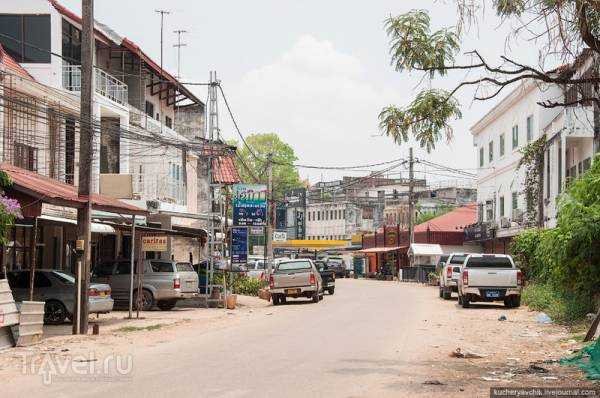
With its absolutely identical facades and crooked streets, Vientiane confused me and became the first city in the world where I ever got lost. For more than an hour, my friend and I – both excellent navigators with an infallible sense of orientation in any terrain – wandered through the unlit streets of evening Vientiane in search of a hostel, about which I knew only the street name and house number, but in Laos no one will help you with this information. I walked along streets where the eye could not catch a single house to remember the location. All the houses seemed familiar and unfamiliar at the same time – like a desert mirage.

After our tuk-tuk was doused with water at one of the intersections in honor of the New Year, we were completely soaked. Our sneakers squelched as we walked. It quickly got dark, and mosquitoes swooped in. Wet clothes attracted mosquitoes – we wanted to quickly find our way home. The search for the legendary “Sihom Road” was endless – we wound like Theseus in the Minotaur’s labyrinth, through absolutely identical neighborhoods. No one was coming our way, and there was no one to ask for an address in Laos – here they don’t navigate by postal codes or names. Around the next turn, we accidentally came to an intersection with a traffic light. There are very few traffic lights in the Laotian capital, and that controlled intersection immediately reminded me how to get home. Five minutes later, we were home.

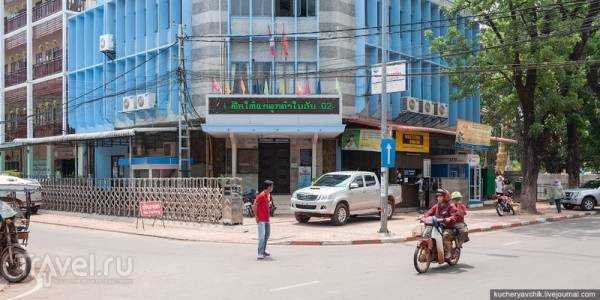
The central part of Vientiane looks neat and even clean. There is no trash lying along the roads, separated by painted curbs. Apparently, they clean it up often. In fairness, it should be noted that it is mainly tourists who walk around the center of Vientiane, and there are quite a few of them in the capital. Most backpackers either stay in the city for a short time, after which they immediately leave for Vang Vieng, or fly directly to Luang Prabang to continue their journey through the jungles of northern Laos. There is much less tourism and tourists in Vientiane itself than in Luang Prabang.

Laos is incredibly peaceful and safe, but there are police boxes on the main streets of Vientiane, and some important streets can be closed off with a drawbridge of aluminum fencing, like in China.
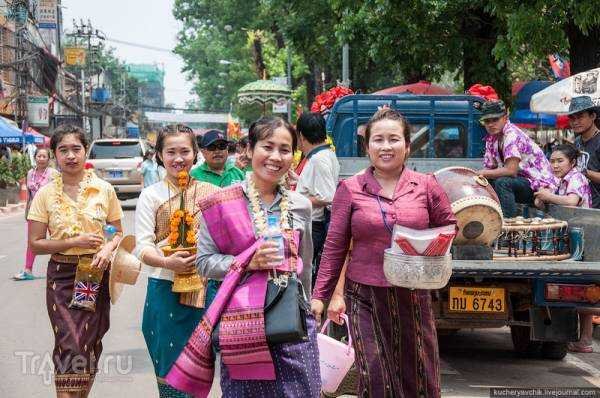
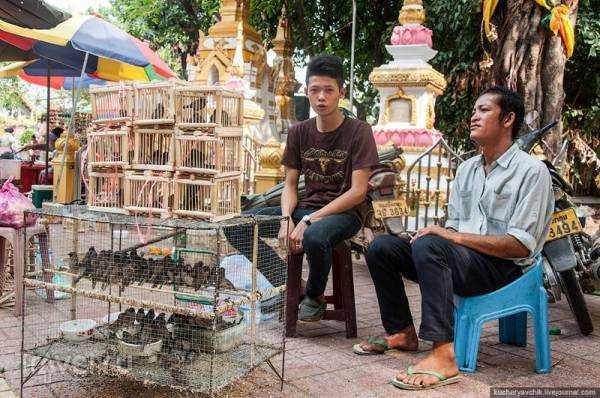
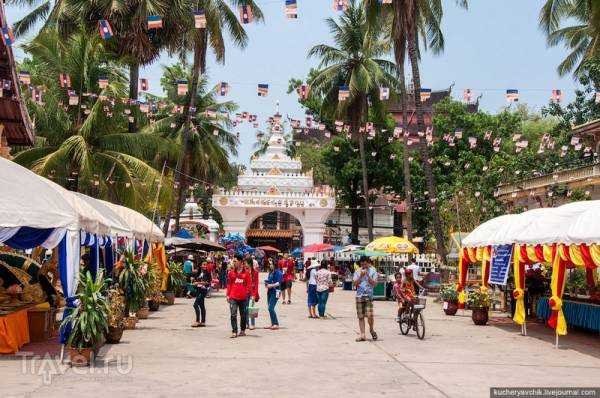
Having started the day before in Luang Prabang, the New Year celebrations continued in Vientiane. In colorful clothes, people in large groups (probably families and relatives) went to monasteries.



Source: travel.ru