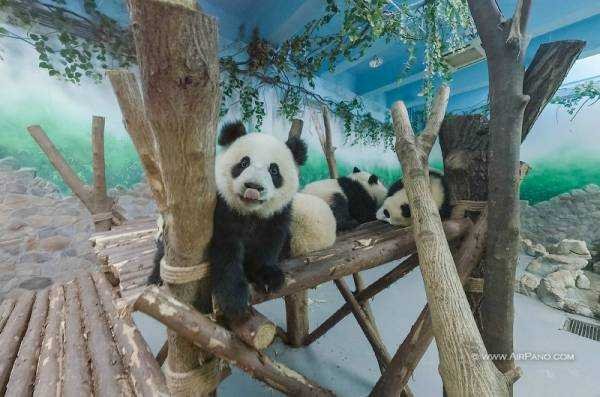
In the wild, giant pandas (Latin: Ailuropoda melanoleuca) live only in China, and only in a few mountainous regions of the country. This species of animal was considered endangered for a long time: poaching and uncontrolled deforestation led to the fact that in 1976 there were only a thousand bamboo bears in the wild.
Having realized the problem, the Chinese authorities took a number of conservation measures: in particular, more than 60 parks with an increased level of protection were created. As a result, by 2016 the number of pandas in the forests increased to 1,864 individuals, and two-thirds of them live in safe areas. In total, taking into account the inhabitants of zoos, there are about 2,060 giant pandas in the world.

Although still small in number, they are no longer endangered: their species status is now vulnerable. The presence of protection and breeding centers has played a huge role in preserving the rare bears. The AirPano team visited one of the most famous such places: the city of Chengdu. According to ancient records, pandas inhabited the nearby forests as early as 4,000 years ago.
Chengdu, located in the Sichuan province in southern China, has an ancient history and interesting monuments, but first and foremost it attracts visitors with the opportunity to see black and white bears. Numerous images of the famous animals remind visitors of this already at the airport.

The Chengdu Research Base of Giant Panda Breeding has been operating on the outskirts of Chengdu since 1987. Its first inhabitants were six giant pandas rescued from dangerous conditions in the wild. Over the 30 years of the center's work, 176 giant pandas have been born, and now about a hundred adult animals live there.
The center is open to visitors: this allows collecting additional funds for its work. In addition to buying an entrance ticket, you can make a donation to the panda protection fund. As a souvenir, tourists will receive a T-shirt, a soft toy, and a sponsor certificate.

The park's territory is divided into several zones: museums, information points, a rehabilitation center for injured animals and enclosures for pandas of different ages. And it's not just about bamboo bears: Panda Base even has red or small pandas (Latin: Ailurus fulgens). Not everyone knows that they are the true representatives of the panda family, and large pandas belong to the bear family. However, both of these animal species have a common ancestor and in the wild they live in the same areas in the highland forests of China.
The Chengdu Research Center is very large, and it is difficult to visit all the enclosures in one day. To do everything, it is recommended to explore the park by electric car. If you come in the season from May to September, it is better to come at the very opening of the park or a little earlier: in the cool morning hours, the animals are quite active, but as soon as the thermometer rises, even the smallest playful pandas become sleepy and go into covered enclosures. And on especially hot summer days, the animals are generally transferred to air-conditioned rooms. And although Panda Base has no official closing hours, by 6 pm there are usually no tourists on the territory.
The process of feeding pandas is very interesting. Each adult panda needs 30-40 kg of bamboo per day, but since this plant does not grow in such quantities in artificially created parks, the animals are fed a special “panda pie” based on bamboo fibers. It tastes like traditional apple pie with nuts; even the park employees like to eat it!
It would be a mistake to think that pandas eat only bamboo: their ancestors were meat eaters, so modern bamboo bears are technically predators. In the wild, they sometimes eat eggs, small birds, animals, insects, and carrion: animal food is a necessary source of protein for pandas.
However, the basis of their diet is still bamboo: in the course of evolution, the panda's body has adapted to the plant, which is widespread in their habitats. The "thumb" on the front paws is a modified wrist bone and allows them to handle even the thinnest bamboo shoots, and the esophagus and stomach are lined with a thick layer of elastic mucous tissue to protect them from bamboo splinters.
In addition, pandas are not indifferent to sweets, getting this taste from fruits and vegetables. Bamboo bears prefer apples, and their smaller “brothers” prefer pumpkin.
The pandas from Chengdu became the heroes of AirPano panoramas thanks to our team, together with our colleagues from UtoVR, working here as consultants on shooting 360° photos and 360° videos for Pandapia, and also worked on post-production. The shooting turned out to be incredibly exciting: pandas are among the world leaders in “audience sympathies”; however, unlike puppies and kittens, they are too few in number, so there are fewer photos of them. Truly unique is the panorama from the incubator with a small panda. From the moment of birth until adulthood, the animal increases in size by 1000 times!
When filming animals, there is always the element of surprise: at some point, when the equipment is already turned off and you are about to leave the set, the bear cub suddenly starts tumbling uncontrollably. Baby pandas are given daily baths: they are dipped in a bath and doused with water to make them cooler, and this is also an unforgettable sight.
Each panda in the reserve has its own name. I remember Star, Milky Way, Shadow Lover. Pandas or groups of pandas are assigned their own keeper: if a panda moves to another reserve or zoo, the keeper accompanies the animals to their destination and then meets them upon their return. And finally, the Panda Base center has official ambassadors. Among them are the famous actor Jackie Chan, the popular Russian singer Valeria and other famous people from China and the entire planet.
But despite the comfort created for the pandas in this center, the conditions are still far from natural. The bamboo bears lead a more secluded life in the mountain reserve Dujiangyan Panda Base and Center for Disease Control, located 55 kilometers from Chengdu. Pandas come here for various reasons: some are born there, and some are brought for treatment. Enclosures have been created here for their smooth adaptation to subsequent life in the wild and for a peaceful existence in “old age”. Part of the reserve is completely wild, differing from the natural habitat only in the high level of protection of rare animals. This territory is so vast that you can walk around it for a whole week without meeting a single panda!
In total, Dujiangyan Panda Base and Center for Disease Control occupies over 50 hectares, and all able-bodied animals are given complete independence. They do not even have special feeding places, but specialists monitor their charges remotely, and if they see that a confused panda cannot find food for a long time, they put bamboo under it.
You can see what a safe “panda oasis” looks like from above using AirPano panoramas.

Virtual tour
Photo Gallery
Source: travel.ru